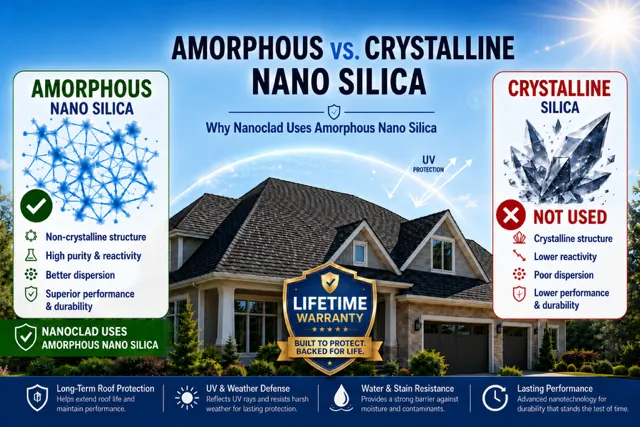
Amorphous vs. Crystalline Nano Silica: Why the Difference Matters
Nano silica is one of the most important ingredients behind Nanoclad Roof Shield’s long-lasting protection. But not all silica is the same.
When people hear the word “silica,” they may think of construction dust, quartz, or crystalline silica exposure. That can create confusion, because silica can exist in different physical forms — and those forms matter.
Nanoclad uses amorphous nano silica, not crystalline nano silica. This distinction is important because amorphous silica and crystalline silica have different structures, different properties, and different safety profiles.
What Is Silica?
Silica is a naturally occurring compound made of silicon and oxygen. It is found in materials such as sand, quartz, stone, and many mineral-based products.
In protective coating technology, silica can be engineered into extremely small particles. These nano-scale particles can help improve surface performance, water resistance, durability, and protection against environmental aging.
However, the structure of the silica is what determines how it behaves.
The two major forms discussed most often are crystalline silica and amorphous silica.
What Is Crystalline Silica?
Crystalline silica has a highly ordered, crystal-like structure. Quartz is one of the most common examples.
The health concerns commonly associated with silica usually relate to respirable crystalline silica dust. This is the very fine dust that can be created during certain industrial or construction activities such as cutting, grinding, drilling, or crushing materials that contain quartz or other crystalline silica.
When respirable crystalline silica dust is inhaled over time in occupational settings, it is associated with serious health risks. OSHA states that workers who inhale very small crystalline silica particles are at increased risk of diseases including silicosis, lung cancer, chronic obstructive pulmonary disease, and kidney disease. IARC has classified crystalline silica inhaled in the form of quartz or cristobalite from occupational sources as carcinogenic to humans.
That is why the distinction between crystalline and amorphous silica is so important.
What Is Amorphous Silica?
Amorphous silica is different. Instead of having a rigid, crystal-like structure, amorphous silica has a non-crystalline structure.
This difference in structure gives amorphous silica different properties and a different safety profile than respirable crystalline silica. IARC has reported that crystalline silica from occupational sources is classified as carcinogenic to humans, while amorphous silica could not be classified as to its carcinogenicity based on the available evidence.
In simple terms, the major carcinogenic concern is tied to respirable crystalline silica dust, not amorphous silica used in a properly formulated protective coating.
Nanoclad Roof Shield uses amorphous nano silica because it provides the performance benefits of advanced silica technology without relying on crystalline silica.
Why Nanoclad Uses Amorphous Nano Silica
Nanoclad Roof Shield is designed to protect asphalt shingles from environmental aging. The amorphous nano silica particles in the formula are extremely small, allowing them to bond with the roof surface and create a protective barrier.
This barrier helps defend against several of the conditions that contribute to roof aging, including UV exposure, moisture absorption, and surface wear.
For asphalt shingles, UV damage is one of the leading causes of long-term deterioration. Sun exposure gradually dries out shingles, breaks down the asphalt, and contributes to brittleness, cracking, fading, and granule loss.
Nanoclad Roof Shield’s amorphous nano silica technology helps block up to 96% of UV rays, reducing one of the primary causes of premature shingle aging.
Performance Without Crystalline Silica
Nanoclad does not use crystalline nano silica in Roof Shield.
That matters because homeowners deserve products that are both effective and responsibly formulated. Nanoclad’s amorphous nano silica technology provides roof protection benefits while avoiding the use of crystalline silica, the form commonly associated with respirable dust concerns in occupational environments.
The result is a protective roof treatment that is designed for long-term performance, surface protection, and homeowner confidence.
How Amorphous Nano Silica Helps Protect Your Roof
Once applied, Nanoclad Roof Shield bonds with the surface of asphalt shingles and helps create an invisible protective layer.
This can help:
Reduce UV-driven shingle aging
Improve resistance to moisture absorption
Support longer-lasting roof performance
Help shingles maintain better durability over time
Reduce premature weathering
Extend the useful life of a serviceable roof
Unlike thick paints or opaque coatings, Nanoclad Roof Shield is designed to protect without changing the natural appearance of the roof. It does not create a heavy film or painted look. Instead, it works at the surface level to help shield shingles from the environmental conditions that slowly break them down.
A Smarter Approach to Roof Preservation
Many roofs are replaced before the shingles have reached the end of their potential service life. In many cases, the roof has not suddenly failed — it has slowly aged from years of sun, heat, water, wind, and seasonal weather exposure.
Nanoclad Roof Shield was created to help homeowners protect the roof they already have.
By using amorphous nano silica, Nanoclad provides advanced surface protection while avoiding crystalline silica. By helping block UV exposure, repel water, and reduce environmental wear, Nanoclad Roof Shield helps extend roof life and delay unnecessary replacement.
That means lower long-term costs for homeowners, fewer usable shingles going to landfills, and better protection for one of the most important parts of the home.
Built to Protect. Backed for Life.
Nanoclad Roof Shield is more than a roof treatment. It is a roof preservation system designed to help asphalt shingles last longer.
With amorphous nano silica technology, UV-blocking protection, water resistance, and Nanoclad’s Lifetime Roof Replacement Credit Warranty, homeowners can feel confident they are choosing a smarter, safer, and more sustainable way to protect their roof.
Nanoclad uses amorphous nano silica — not crystalline silica — because the difference matters.