Do Impact, Fire, and Wind Ratings Tell the Whole Story About Roof Protection?
When homeowners compare roof rejuvenation or roof protection products, it is easy to get pulled into impressive-sounding test results.
Impact resistance.
Fire resistance.
Wind resistance.
Those are all legitimate areas of roof performance. They matter. If a roof treatment can help improve outcomes in those categories, that can provide real value for property owners.
But they do not necessarily tell the whole story about whether a roof protection product will deliver the best outcome for the average homeowner.
At Nanoclad, we believe the more important question is this:
What is actually aging your roof every single day?
Because for most asphalt shingle roofs, the biggest threat is not one isolated event. It is years of daily exposure to sun, heat, rain, snow, freeze-thaw cycles, moisture, and gradual granule loss.
Event Resistance vs. Everyday Roof Aging
Some roof treatment companies highlight tests related to hail impact, wind uplift, or fire resistance. These tests can be useful, especially in certain climates or risk zones.
For example, UL 2218 Class 4 is the highest impact-resistance rating under that standard, and Class 4 shingles are tested against the impact of a 2-inch steel ball dropped from 20 feet. (gaf.com)
That is useful information. But it does not mean a roof is hail-proof.
Real hail is not a perfect steel ball in a lab. It varies in size, shape, density, wind angle, storm duration, roof age, roof slope, and temperature. Even impact-resistant shingles can still be damaged badly enough to require replacement in severe storms.
The same is true with wind and fire testing. ASTM D3161 includes fan-induced wind-resistance classifications for shingles, including Class F at 110 mph. (owenscorning.com) UL 790 fire ratings classify roof coverings based on fire exposure testing, with Class A intended for severe fire test exposures. (UL Solutions)
These tests can matter. They can help measure how roofing materials perform in specific conditions. But they are primarily event-based performance categories.
They help answer questions like:
How does this material perform under a defined impact test?
How does it perform under a defined wind test?
How does it perform under a defined fire exposure test?
Those are important questions.
But they are different from the daily roof-life question:
Is the treatment helping the roof resist the everyday forces that gradually wear it out?
What Actually Wears Out Most Asphalt Shingle Roofs?
Most asphalt shingles do not fail because of one dramatic event. They usually fail because the roof slowly loses its ability to protect itself.
The key aging factors include:
UV exposure
Heat
Water absorption
Freeze-thaw cycling
Granule loss
Brittleness
Surface cracking
Weakening of the shingle surface over time
Granules are a critical part of the asphalt shingle system. They are not just there for colour. The Asphalt Roofing Manufacturers Association describes shingle granules as ceramic-coated crushed rock particles that coat the face of the shingle and help provide UV protection, durability, and longevity. (asphaltroofing.org)
Once granules begin to loosen or wear away, the asphalt layer becomes more exposed to sunlight, moisture, and temperature stress. That is when aging can accelerate.
So while hail, wind, and fire performance can be valuable, the everyday roof-life question is usually more practical:
Is the treatment helping the shingles resist the forces that age them every day?
The Performance Areas Homeowners Should Care About Most — Prioritized
Not all roof-performance categories matter equally for every homeowner.
Some factors affect your roof every single day. Others matter most during specific events, such as hailstorms, high-wind events, or fire exposure.
That does not mean event-based performance is unimportant. A roof protection product that improves impact, wind, or fire performance may absolutely provide added value.
The point is simply that when homeowners are thinking about roof preservation and long-term roof life, the highest-priority categories are usually the ones connected to everyday aging.
Here is a practical way to think about the priorities.
1. UV Protection — ★★★★★ 5/5 Priority
UV exposure is one of the most constant threats to an asphalt shingle roof.
Every sunny day, your roof is exposed to ultraviolet radiation. Over time, UV contributes to drying, brittleness, surface breakdown, and weakening of the asphalt/granule bond.
This is one of the most important roof-preservation categories because it affects almost every asphalt shingle roof, regardless of whether the home ever experiences a major hailstorm, wildfire, or extreme wind event.
A roof treatment should help reduce the impact of UV exposure, not just look good immediately after application.
2. Granule Retention — ★★★★★ 5/5 Priority
Granules are one of the roof’s main protective layers.
They help shield the asphalt beneath from UV exposure, weather, and surface wear. Once granules start to loosen and shed, the roof becomes more vulnerable to aging.
For long-term roof preservation, granule retention is one of the most important performance areas.
A meaningful roof protection product should help preserve the shingle surface and reduce the forces that contribute to granule loss over time.
3. Water Repellency / Hydrophobicity — ★★★★★ 5/5 Priority
Water repellency is one of the easiest performance improvements for homeowners to see.
A treated shingle should repel water more effectively than an untreated shingle. This matters because water absorption, moisture cycling, and freeze-thaw stress can all contribute to long-term roof aging.
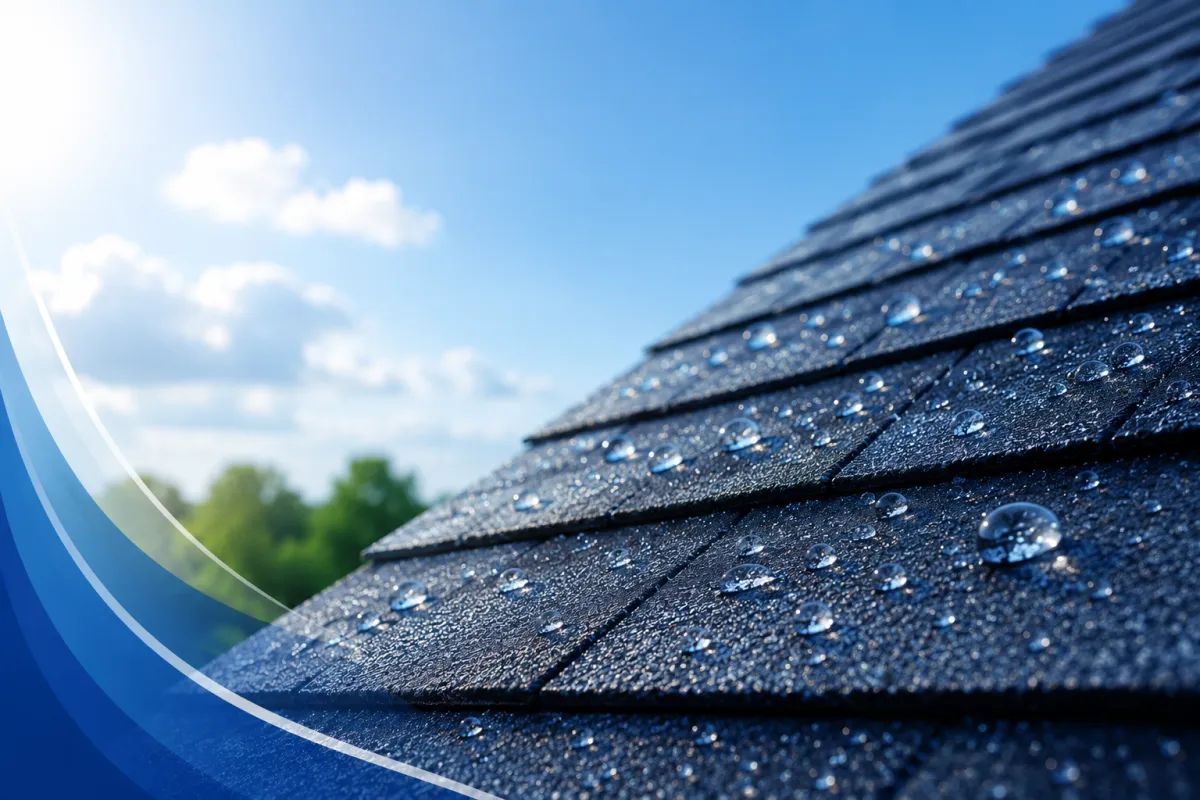
This is where Nanoclad’s hydrophobic performance is highly visible: water beads and sheds from the surface rather than soaking in.
4. Performance After Accelerated Aging — ★★★★★ 5/5 Priority
Initial performance is useful. Long-term performance is more important.
A product may bead water or improve surface behaviour shortly after application, but the real question is how it performs after UV exposure, heat, moisture, freeze-thaw cycles, and weathering.
For roof preservation, treated shingles should ideally be tested against untreated shingles after accelerated aging. This helps answer the question homeowners actually care about:
Will this help my roof perform better over time?
5. Flexibility / Reduced Brittleness — ★★★★☆ 4/5 Priority
As shingles age, they become drier and more brittle.
A brittle roof is more vulnerable to cracking, granule loss, weathering, and impact damage. Maintaining or improving resilience can be important, especially for older roofs that still have serviceable life remaining.
The key question is not simply whether a treated shingle performs well immediately after application. The better question is whether the treatment helps the shingle remain more resilient over time.
6. Impact Resistance — ★★★☆☆ 3/5 Priority
Impact resistance can matter, especially in hail-prone regions.
If a roof treatment improves impact performance, that can be a valuable benefit. Better impact performance may help a roof handle certain storm conditions more effectively than it otherwise would.
However, homeowners should be careful not to interpret improved impact resistance as hail-proofing. Severe hail can still damage roofs, including impact-resistant shingles.
UL Solutions and IBHS have noted that while UL 2218 impact-resistant certifications have helped improve shingle performance in hailstorms, UL 2218 is based on physical breach damage viewed from the underside of shingles and does not account for denting or granule loss that homeowners or insurance adjusters may observe. (UL Solutions)
So impact resistance is valuable, but it is best understood as an event-based benefit rather than one of the main everyday aging factors.
7. Wind Resistance — ★★☆☆☆ 2/5 Priority
Wind resistance can be meaningful, especially in regions that regularly experience strong wind events.
If a treatment helps improve shingle surface integrity, adhesion, or resistance to weather-related stress, that may provide added value. However, real-world wind performance depends on many factors beyond the treatment itself, including roof installation, shingle age, fasteners, seal strips, roof design, and exposure.
For most homeowners, wind resistance is a useful supporting benefit, but it is generally not as central to roof-life extension as UV protection, granule retention, water repellency, brittleness reduction, and long-term aging resistance.
8. Fire Resistance — ★★☆☆☆ 2/5 Priority
Fire resistance is important, especially in wildfire-prone areas or where local codes and insurance requirements make fire performance a major concern.
If a treatment improves fire-related performance, that is a positive added benefit. However, for many homeowners, fire resistance is more situational than daily. Many asphalt shingles are already manufactured as part of fire-rated roofing systems, so the practical impact of a post-installation treatment depends on the roof, the product, the test method, and the property’s risk profile.
Fire resistance should not be dismissed, but for everyday roof preservation, it is usually not the first factor homeowners should prioritize.
The Problem With Focusing Only on Impact, Wind, and Fire
Impact, wind, and fire performance can all be valuable. If a roof treatment improves those outcomes, that can add real value for property owners.
The issue is not that those categories do not matter.
The issue is that they are usually event-based categories. They matter most when a specific event occurs: a hailstorm, a severe windstorm, or a fire exposure scenario.
For most roofs, the more constant threat is everyday aging.
That includes:
UV exposure
Heat
Water absorption
Freeze-thaw cycling
Granule loss
Brittleness
Surface weathering
Long-term degradation
So homeowners should not ignore impact, wind, or fire performance. But they also should not treat those categories as the entire definition of roof protection.
A better question is:
Does the product help the roof perform better against both everyday aging and specific event-based risks?
At Nanoclad, our main focus is helping asphalt shingles resist the everyday forces that gradually shorten roof life, while continuing to evaluate and validate performance across other important categories as well.
What Makes Nanoclad Different?
Nanoclad Roof Shield is designed to protect asphalt shingles at the surface level where weathering happens.
It is a water-based nano-silica roof treatment designed to:
Improve water repellency
Reduce water absorption
Help protect against UV-related degradation
Support granule retention
Help slow the daily aging process
Extend the useful life of qualifying asphalt shingle roofs
Nanoclad is not paint.
It is not a cosmetic coating.
It is not a replacement for a failed roof.
It is a roof protection treatment for asphalt shingle roofs that still have serviceable life remaining.
The Right Question Is Cost Versus Value
There are several roof rejuvenation and roof coating options on the market. Homeowners should compare them carefully.
The best question is not simply:
“Which product has the most impressive-sounding test?”
The better question is:
“Which product gives me the best cost/value outcome for my actual roof?”
That means looking at:
Application cost
Expected performance life
Warranty
Water repellency
UV protection
Granule retention
Whether the roof appearance changes
Whether the product is suitable for asphalt shingles
Whether the roof is inspected before treatment
Whether performance is verified after application
Whether the claims relate to everyday roof aging or only isolated event-based testing
When viewed through that lens, Nanoclad is designed to be a strong value option for homeowners who want to protect their roof before replacement becomes necessary.
What Homeowners Should Ask Before Choosing a Roof Treatment
Before choosing any roof protection or rejuvenation product, ask these questions:
What does the product actually do to the shingle?
Does it repel water?
Does it help protect against UV exposure?
Does it support granule retention?
How long is performance expected to last?
What warranty is provided?
Is my roof inspected first to confirm it qualifies?
Are the claims based on real testing?
Do the test results apply to real-world aging, or only isolated lab events?
Does the treatment help with the everyday factors that actually wear out asphalt shingles?
Does it also provide value in specific event-based categories such as impact, wind, or fire resistance?
Final Thought
Impact, fire, and wind resistance are useful performance categories. They can help tell part of the story, and improvements in those areas may provide real value for property owners.
But they are not the whole story.
For most homeowners, the most meaningful roof protection benefits are the ones that help fight the everyday forces of roof aging: UV exposure, water absorption, granule loss, brittleness, and freeze-thaw stress.
That is where Nanoclad focuses first.
Because protecting a roof is not only about preparing for rare events. It is about helping your shingles perform better every day.